
24.2.14

11.2.14
Some heartening (?) thoughts c/o Deleuze the night before I leave for the CAA Conference.

Art is just territorial pissing,

....or some other sort of angry display.

and talking is dirty.... But nothing is so shameful as the intellectuals who travel only to do so.
27.1.14

24.1.14

4.10.13

29.9.13
We are not the ones using obscure language: intellectuals in Godard's La Chinoise
 |
So this means you're leaving the university?
Leaving if you want. I'm breaking with a widespread attitude.... |
 |
| Isn't Vietnam an actor? Yes, Vietnam. |
 |
| We are not the ones using obscure language! It's our society which hermetic and closed.... |
24.9.13
Emergency Currency
I get excited about banknotes but more exciting than official banknotes are emergency banknotes. From the days when Germans used wheelbarrows as purses:


"Notgeld (emergency currency) was issued by cities, boroughs, even private companies while there was a shortage of official coins and bills. Nobody would pay in coins while their nominal value was less than the value of the metal. And when inflation went on, the state was just unable to print bills fast enough. Some companies couldn't pay their workers because the Reichsbank just couldn't provide enough bills. So they started to print their own money - they even asked the Reichsbank beforehand. As long as the Notgeld was accepted, no real harm was done and it just was a certificate of debt. Often it was even a more stable currency than real money, as sometimes the denomination was a certain amount of gold, dollars, corn, meat, etc."
These are all from the flickr site of Miguel Oks.
(Thanks to Michael Shick for sending these my way).
10.8.13
Whole Earth to Whole Foods

In my statement I wanted to explain my appeal for these books, describing my interest in the "how-to" manual as a genre. As the ancestor of the homesteading manual and the precursor of the DIY zine (or now, more generically, about.com) the "manual" quite radically cuts out the middle-man and the expenses of training.
However, I also wanted to show the other secret attraction of these books, which is that the manual also allows for the formation of an alternative identity, functioning as an aide in self-actualization/ transformation.
Ironically, it is to this very radical movement of intentional communities that we owe the greenwashed environmentalism of today. I stressed that perhaps the manuals were almost too effective, and that eventually, the radical subjectivities associated with the intentional communities movement were commodified, its fonts and design sensibilities were raided. The middle man was brought back into the picture, not as Whole Earth but as "Whole Foods".

2.8.13

9.6.13


25.5.13

20.3.13

29.12.12
Société Anonyme

24.12.12
The Principle of Mimicry

When held in hand, one barely notices the difference between these two coins minted by successive French political regimes – the July Monarchy (1830-1848) and the Second Republic (1848-1852). In the latter (the coin from 1851)the young Marianne (allegory of the Republic) cuts a similar profile to that of her monarchic foil, the double-chinned King Louis Philippe, Duc d'Orleans. Likewise, on the tails side, the only difference with the new Republican coin is the slogan: " Liberté, Egalité, Fraternité."
15.7.12
Art Farce, Salon des Independents, 1910.
 |
| Et le soleil s'endormait sur l'adriatique by J.R. Boronali (1910) |
 |
"J.R. Boronali" and the painting in progress.
Bottom image and caption from The Art World, May 1917.
|
20.5.12
Modernism, the young John Maynard Keynes, and the art market
Merve Emre describes how writings on art by Bloomsbury member and patron John Maynard Keynes can be seen as adumbrations of The General Theory of Employment, Interest and Money (1936) at The Modernism Lab.

10.1.12


24.10.11
Having a Telephone is Boring. Not Having a Telephone is Boring
I applaud all ideas, but nothing else, only the ideas interest me and not what gravitates around them, profiting from ideas disgusts me. "One has to live," you tell me? You know as well as I that our existence is short compared to the profit one can gain from an invention; we're on the earth since the day before yesterday and we'll die tomorrow. Cubism was born one morning only to die that evening, then Dada appeared and was, actually, just as ephemeral. The evolution continues; some person will find the name of a new package for a bygone spirit, and so forth.
The Dada spirit only really existed from 1913 to 1918, an era during which it
never stopped evolving and transforming itself. After that time, it became as
uninteresting as the output of the Ecole des Beaux-Arts or the static elucubrations
offered by the Nouvelle Revue Francaise and certain members of the Institute. In the
attempt to prolong its life, Dada has closed in upon itself. I am sorry if, with these
lines, I'm wounding friends whom I love dearly, or disturbing certain colleagues
who perhaps are counting on a profit from Dadaism!
I couldn't tell you what will happen at this point; all I can assure you is that
our state of mind is not the same as it was from 1913 to 1920 (if you like), and that consequently it will show itself differently. Don't think that I'm standing in my shirtsleeves at midnight in July, contemplating the moon, don't worry, I have my good sense-if there is such a thing as good sense! What I am sure of is that it is impossible to stop movement. Money itself has value-or it doesn't; paper would perhaps be worth more than gold if it were given to me to discover gold mines as large as the coal pits of Cardiff. People class individuals into two categories: "unserious" and "serious."No one until now has been able to explain to me what a serious man is. I will make the attempt here myself. I think that you call a man serious when he is able to provide for his neighbors, his family, his friends, on condition that to these ends he put the interest on his capital to work. An unserious man is one who confuses interest with capital, and doesn't seek to make dollars with his ideas-from an artistic viewpoint, a copyist at the Louvre will always be more serious than I am! Dada, you see, was not serious, and that is why it won over the world like wildfire. If some people take it seriously now, that's because it's dead! Many people will call me a killer, but they're deaf and shortsighted. Anyway, there are no killers; are tuberculosis and typhoid killers? Are we in control of our lives? In my opinion, there is only one killer, the one who created the world. But, since no one created the world, there are no killers, Dada will live forever! And thanks to that, art dealers will make their fortune, publishers will treat themselves to cars, writers will get the Legion of Honor, and I ... will stay Francis Picabia!
One must be a nomad, traveling through ideas as one travels through countries and cities, eating parakeets and hummingbirds, swallowing live marmosets, sucking the blood of giraffes, feeding on the feet of panthers! One must sleep with gulls, dance with a boa constrictor, make love with heliotropes, and wash one's feet in vermilion! One must disguise church interiors as ocean liners and ocean liners as artichokes with cream, make statues come out of the sea and recite verses to passing steamers, go out naked then put on a tuxedo at home; one must hear confessors' confessions, never again see the people one knows, above all, never put the same woman twice in one's bed, unless one has a mistress who cheats on you every day with a new lover! All that is a lot easier than the faith of a copper- smith, who always laughs at what's funny and finds black dark and white light. The coppersmith warms up in the sun because he's cold; don't be cold, and you'll see how much the sun looks like rain!
Existence is tolerable really only on condition that one lives among people who have no ulterior motives, no opportunists, but that would be asking the impossible...Talent doesn't exist, masterpieces are just documents, truth is the pivot on the scale. Everything is boring, no? Falling leaves are boring, new leaves are boring, heat is boring, cold is boring. Grandfather clocks that don't chime are boring, those that do chime are boring. Having a telephone is boring, not having a telephone is boring. People who die are boring, just as are those who don't! Look how badly the world is put together, why doesn't our brain have the force of our desires? But all that matters very little, paintings in museums are masterpiece- fossils. A man is called tasteful because he shares the taste of others; for you, life is a guitar on which one plucks only the same tune forever.
Translated by Matthew S. Witkovsky.
Francis Picabia, "M. Picabia se sépare des dadas," Comoedia, May 11, 1921, reprinted in Francis Picabia, Ecrits 2, ed. Olivier Revault d'Allonnes (Paris: P. Belfond, 1978), pp. 14-15.
4.10.11


25.8.11
Sociological Walk in another Brooklyn
September 8 (@4pm) French conceptual artist Fred Forest replicates his infamous 1973 sociological excursion through working-class neighborhood of Brooklin, São Paolo. Given that this time he is starting on N.7th street, (the heart of the party, so to speak) the tour should be an incisive study. Curated by the awesome Ruth Erickson.


7.7.11
Venice Biennale Posts
Reporting on the 54th Venice Biennale for Black Book, in three posts. The last one is best.
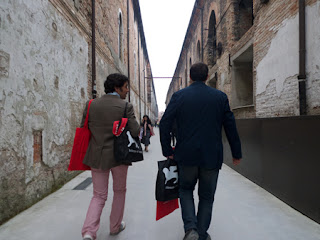
1 Smells Like Art
2 Institutional Critique and Nationalism
3 You Never Sausage a Place

1 Smells Like Art
2 Institutional Critique and Nationalism
3 You Never Sausage a Place
5.5.11
22.2.11

10.2.11
3.2.11
Not Not Not Not Unreal
By my buddy Jon Clark and Spencer Longo. The effect is unreal. The FX are mostly done in camera.
2.2.11
17.1.11
On archival 'fever'
"Can its underlying cause be expediently diagnosed as a generic effect of globalization, as anxiety over theses on “the end of history” (from Alexander Kojève to Francis Fukuyama), or the failure of utopian paradigms and loss of faith in western notions of historical causality and progress? For art historians and critics, this is a deeply paradoxical state of affairs because the unraveling of historical paradigms, especially those beholden to a teleological, revolutionary temporal logic, suggests we should no longer put our faith in future retrospective viewpoints or judgments. However, we have yet to invent satisfying critical-historical alternatives to looking forward or looking back as we live in the present. A heightened historical, sense of self-reflexivity, in the spirit of the sort found in the work of Mona Vătămanu and Florin Tudor, is indispensable."
More of Vivian Rehberg's crisp essay in Jeu de Paume's Le Magazine this month.


12.8.10
disco party 9-5
Seth Price's bumpin 8-hour work mix here. Tests at my "day job" are already in process.
Seth Price: I didn’t have a particular use in mind. I was thinking about work days, where different sets of working hours represent different kinds of work and different cultural areas: a union job, an office job, an art gallery, a boutique… But it’s true, I liked the fact that the track could be played perfectly, start to finish, during an 8-hour work day, so yes, a work mix, why not.-from an interview with Boško Blagojević, here.
5.8.10
Dispersion and Jogging.com
I saw David Joselit deliver a lecture on the subject of dispersion and circulation last winter. He began by asking: How do we produce value and meaning in a world of overproduction? He answered with the following: The only way to derive "meaning" from art is by "moving it"*:
Joselit described how we now rely on an "epistemology of search" to identify value in art. And this value has been untethered from material and assigned to the amorphous bonds that combine unlike objects (telecommunications, human relations). Rules for this epistemology are as follows:
1. images multiply
2. value is produced by circulation
3. objects are constituted (ie: an object d'art is designated a 'work of art').
With this in mind, I am reminded of a new crowd-sourced curatorial project on jogging.com:

I am looking through the anonymous images on Jogging.com since the project has been initiated: sliced Jpeg of two baseball hats against one another and two different colored woods. A totem pole with a bear carved into it, fitted with an airline head-rest. Barbara Streisand's home. They are so full of signifiers and so empty at once that they are exhausting, which is good.Value is not derived from these because they are contemplative and significant but if I, and enough people "Like" them/reblog, their value increases.
As surely the makers know all too well, the project is the successful envisioning (as a online curatorial project) of what was discussed in an AUDC (Sumrell/Varnelis) essay, "Revenge Against Objects" in 2006. Post-modern society, they write, no longer has need for material culture. Of course, "All objects are now wild signs, free-floating signifiers unable to represent anything specific themselves, part of the mechanism of circulation, which has become a goal in and of itself."
Joselit described how we now rely on an "epistemology of search" to identify value in art. And this value has been untethered from material and assigned to the amorphous bonds that combine unlike objects (telecommunications, human relations). Rules for this epistemology are as follows:
1. images multiply
2. value is produced by circulation
3. objects are constituted (ie: an object d'art is designated a 'work of art').
With this in mind, I am reminded of a new crowd-sourced curatorial project on jogging.com:
Jogging will now enter an experimental mode of image distribution called Positive Feedback. .....
.......We ultimately hope for the entire blog to become a self-regulatory process, allowing viewers the chance to both create content and vote on the relevance of that content to Jogging’s brand for inclusion. When this end is reached, Jogging will become the first artistic ‘being’ to be associated with an anonymous and endless number of identities– a form of production we feel makes the most efficient use of the possibilities our digital location provokes and is most relevant to the blog’s political aim of encouraging a decentralized system of distribution (and creation) for art.
As surely the makers know all too well, the project is the successful envisioning (as a online curatorial project) of what was discussed in an AUDC (Sumrell/Varnelis) essay, "Revenge Against Objects" in 2006. Post-modern society, they write, no longer has need for material culture. Of course, "All objects are now wild signs, free-floating signifiers unable to represent anything specific themselves, part of the mechanism of circulation, which has become a goal in and of itself."
4.8.10
Benjamin Crotty and Gabriel Abrantes

Poor boy falls for daughter of Chinese neo-colonialists in Angola,
with the arcs, score, and stilted dialogue of Hollywood narrative film. The improbable is now plausible.
Liberdade, at the Palais de Tokyo (23 mins).
Svetlana Boym
#4, A Critic, an Amateur, from Notes for an "Off-Modern Manifesto":
If in the 1980s artists dreamed of becoming their own curators and borrowed from the theorists, now the theorists dream of becoming artists. Disappointed with their own disciplinary specialization, they immigrate into each other's territory. The lateral move again. Neither backwards nor forwards, but sideways. Amateurs' outtakes are no longer excluded but placed side-by-side with the non-outtakes. I don't know what to call them anymore, for there is little agreement these days on what these non-outtakes are.
But the amateur's errands continue. An amateur, as Barthes understood it, is the one who constantly unlearns and loves, not possessively, but tenderly, inconstantly, desperately. Grateful for every transient epiphany, an amateur is not greedy.
2.8.10
Coming Up!

Paul & Linda in various guises. (Thanks Michael!)
See also: "Notes on the Paul McCartney Shadow Canon" by Mark Owens, in #20 Dot Dot Dot.
See also: "Notes on the Paul McCartney Shadow Canon" by Mark Owens, in #20 Dot Dot Dot.
20.7.10
REVIEW: Art Papers: Sam Durant, "Dead Labor"

SAM DURANT
ART PAPERS July/ August 2010
PAULA COOPER GALLERY, NEW YORK, March 13-April 17 2010
REVIEWED BY MIMI LUSE
In contemporary American popular culture, work is often represented as an innocuous form of incarceration. Television cubicle-sitcoms like The Office give us the comedy of extreme banality in confined conditions. How easily we forget our indebtedness to a much more radical history for the grey creature comforts of the modern workspace. For modular furnishings and humane amenities like the eight-hour workday, we can respectively thank utopian furniture designers and a series of anarchist-led labor strikes in the late nineteenth century. Taking advantage of our collective memory loss, Dead Labor Day is Sam Durant's historical corrective (Paula Cooper Gallery; March 13-April 17, 2010)
"Capital is dead labour," as Marx's gothic metaphor holds, "which, vampire-like, lives only by sucking living labour." For the exhibition’s eponymous work, Dead Labor Day, Durant built a life-sized gallows whose scaffold platform can be accessed by a set of metal stairs. Gallery-goers who climb it will find a water cooler, with paper cup-dispenser, installed on the platform. The concept is a visual pun: distracted by complimentary Dixie cups, the modern worker finds herself an unwitting hangman of the life-sucking forces of capital. But it is also a superimposition of two discrete historical models of discipline: the theater of punishment and the humane, slow-burning incarceration of the modern working environment. Models upon models.
In the front room, Gallows Composite C (Billy Bailey Gallows, Haymarket Gallows, Rarney Bethea Gallows, Saddam Hussein Gallows), 2010, lies on a mirrored pedestal. Just as modernism provided better living through furniture, the model here is a process of refining capital punishment through the rule of averages. The lightbox Break Room with lnternational Mass Meeting, 2010, shows an upside-down spread of an ideal, sleekly modern, open-concept office break room layered over an archival poster commemorating the four Haymarket martyrs who were hanged in Chicago in 1887. Durant also introduces archival materials at the gallery's front desk – documentation of Grover Cleveland's decision to move Labor Day to the month of September in order to disassociate the holiday from its radical May- Day/ Haymarket origins, for one, and sheathes of economic data; two curve graphs overlaid to show, gracefully, the correlation between economic inequality and a decline in union membership. Offering these materials, Durant demonstrates the increasingly elegant ways in which history ironizes itself; while it might profess a true reflection, it instead turns things topsy-turvy.
Durant's earlier work likewise served to demonstrate this principle. Reflected Upside-down and Backwards, 1999, created a corrupted mirror-image by placing two model- sized versions of Robert Smithson's Partially Buried Woodshed, 1970 (now mostly destroyed), on top of one another. One was charred – as the structure was in 1975 – and the other was pristine enough to file under the text-book header "sculpture in the expanded field." Meeting Smithson's self- supplied definition of a "new monument" as that which “places both past and future into an objective present," Durant’s composite played with the dualities of perceived history and the archives of art history. These works are a painful remedial that force us to accept coexisting versions of history, and burn neural pathways in the process. In his writings on the "archival impulse," Hal Foster describes Durant's work as a counter- memory for our cultural Alzheimer's: "why else connect so feverishly if things did not appear so frightfully disconnected in the first place?"
-Mimi Luse
18.7.10
Network Culture Chart by Kazys Varnelis
5 years old but still.... More here.
| Modernism | Postmodernism | Network Culture | |
|---|---|---|---|
| Political Economy | |||
| economy | production | service | debt |
| capital | monopoly | multinational | transnational |
| regime of accumulation | Fordism | Post-Fordism | Empire |
| forms of consumption | scarcity | affluence | luxury and clustering |
| enemy | revolutionary communism | soviet communism | islamic terrorism |
| Culture | |||
| settlement | suburbia | postsuburbia | exurbia |
| space | abstract | hyperspace | network space |
| subjectivity | autonomous | schizophrenic/fragemented | subsumed into the object |
| media | mass media | niche | long tail |
| dominant mode of art | rupture | critical appropriation | smooth aggregates |
| authorship | author | discursive field | network |
| narratives | Hegelian narratives | end of the grand narrative | neo-Hegelianism |
| music | records | cassette tape, compact disc | file sharing or itunes |
| portable music | transistor radio | cassette walkman | ipod |
| sci-fi fantasy | metropolis | star wars | the matrix |
| past reference | antiquity | 19th c.-1930s modernism | 1960s contemporaneity |
| disease | TB | AIDS | Ebola, Anthrax, Avian Flu |
| war | World War I, II | Vietnam | 9/11 |
| computing | mainframe | personal computer | ubiquitous computing |
| screen-based media | Television | GUI | Web 2.0 |
| urban détournement | the dérive | skateboarding | le parkour |
| Representative Figures | |||
| psychology | Freud | Lacan | Zizek |
| philosophy | Sartre/Heidegger/Wittgenstein | Derrida | Deleuze |
| architecture | Le Corbusier/Mies | Venturi/Eisenman | Gehry/Koolhaas |
17.7.10
I wish we didn't have to have a "World Debate" on this

Is water a commodity or a public right? In an ideal world the issue wouldn't require a heated debate on BBC World. In the audience, Christopher Gasson, with an organization called "Global Water Intelligence" asked that the panel stop referring to water as a "right". Yikes.
Hype Machine
By now everyone is familiar with the hype cycle. You know the drill: the ginned-up enthusiasm of publicists combines with word of mouth (and blog) to create so-called buzz. Articles appear, posing one of three questions. For the new artist: is this the next big thing? For the established artist (or restaurateur): will stratospheric expectations be met? For the figure whose stock is down: can a comeback be staged? Then the release date arrives, or the premiere, or opening; at last the thing itself can contend with its reception. But, wait, now backlash surges alongside the ongoing hype. And understandably, too: it’s not nice being force-fed even the tastiest food. But hold on a second, here comes the backlash-to-the-backlash …
from "The Hype Cycle," April 2008, N+1. More here
27.6.10
Articulate Monsters

Saw Todd Solondz's Life During Wartime at the slick new IndieScreen theatre last night in Williamsburg .
The film could not be clearer in its politics: America is a nation of over-medicated human shells posing as "normals" and living the bland life in Florida. Fine. Not an uncommon viewpoint, especially in independent film. But while Solondz's other films seem morally ambiguous, "forgive and forget" is a lietmotif in this film, down to the theme song, "Life During Wartime," (lyrics written by Solondz and performed by Beck Hansen*). You could dismiss this as Solondz's ironic sensibility. But the movie reinforced these values so 'sweetly'.
From the child who forgives his pedophile father to the woman who works with (and eventually marries) ex-convicts, Solondz articulates and explains the compulsions of the most gruesome offenders. For example, by linking a pedophile's sexual urges to his seemingly innocent compulsion for gum-drops, Solondz implies that the perv has just as little control over his pedophila than he does over a sweet tooth.
Paul Reubens is also in Life During War Time, and during a q+a after the screening last night (hosted by another L magazine contributor, whom I'd never met before) Solondz said he cast Reubens precisely because of the cultural baggage the actor carries with him. Far from a reactionary or sensationalist artistic decision, Solondz is actually exonerating Reubens by hiring him, while at the same time generating a tension with the audience; forcing viewers who have not yet forgotten Ruben's gaffes to sympathize with this scripted character and forgive him.
* not a Talking Heads cover.
Subscribe to:
Posts (Atom)